Cinnamon is a flavor that is so
familiar to us all. The brownish red powder is pervasive in our
everyday lives and is a common flavoring so many recipes and in so many
products that we purchase at the grocery store. But what is cinnamon
really?
Cinnamon is a catch-all term for a spice derived from the bark of several species of trees. The subject of this article
Cinnamomum verum
(Ceylon Cinnamon) known as “true cinnamon,” is native mainly to Sri
Lanka and Southern India; yields a sweet, delicate flavor. However, the
common grocery store cinnamon or
Cinnamomum burmanii is native to Indonesia. There are also the
Cinnamomum loureiroi native to Vietnam that has high intensity spicy flavor or the strong pungent
Cinnamomum cassia
native to China. Although the flavor of all of these may be similar,
the chemical compositions and relative health benefits (and detriments)
are different. I am going to focus this article on true cinnamon
because it has in my opinion it is a lovely plant for any South Florida
garden, has the best flavor, and has the best toxicological
profile.
To
clarify, I am going to start off with a discussion of Coumarin.
Coumarin is a fragrant sweet smelling chemical compound that occurs
naturally in many plants such as lavender, tonka beans and sweet
clover. It smells like newly mown grass or vanilla. It is used in
perfumery medicine and flavorings throughout the world. However, with
high intake it can cause liver toxicity and in
burmanii,
loureiroi and cassia
Cinnamomum varieties, Coumarin is relatively high.
Cinnamomum verum,
on the other hand, has very low concentrations of Coumarin making it,
in my estimation more desirable to use for consumption. Especially
if you consume the quantities of cinnamon that I enjoy the additional
knowledge of the lower Coumarin levels in
Cinnamomum verum.
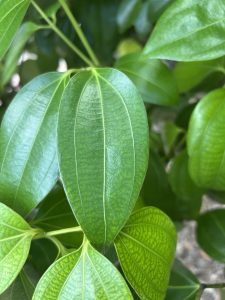 Cinnamomun verum
leaf
Cinnamomum verum
(Common names- Ceylon cinnamon, Sweet cinnamon, or true cinnamon) is a
small to medium evergreen tree native to the tropical evergreen forests
of Sri Lanka and Southern India. Young plants thrive in a shady
environment, but mature plants can handle full sun to shade. The trunk
is slender and greyish brown bark. The leaves are opposite or
sub-opposite, simple, entire, and leathery with the blade ovate to
elliptical defined by the unique three to five conspicuous veins
arising from the base of the leaf. the flowers are individual bisexual
and pale yellow greenish while the fruit is formed in a one seeded
fleshy drupe and begin green then turn purple or black when mature and
are a good food source for birds. The root systems are deep and
spreading and they prefer moist, fertile, soils with good drainage.
The
part of the plant that is most utilized as cinnamon is the inner bark.
Branches roughly 1/2″-2″ in diameter are scraped of the outer bark then
meticulously rubbed with metal bars to release the inner bark that is
carefully cut/scraped off in sheets and then dried to cure and curl.
The dried leaves can be used to make a cinnamon tea or as a flavoring
in dishes. The astringent berries are rarely consumed by human but have
some use in traditional recipes such as jams, chutneys, and preserves
as an herbal infusion. As a plant in the southern Florida garden
cinnamon thrives and can provide a unique texture and depth with its
dynamic foliar appearance and full structure. Once established they
require little maintenance and slowly grow into a round shape then
branching out as a medium sized tree.
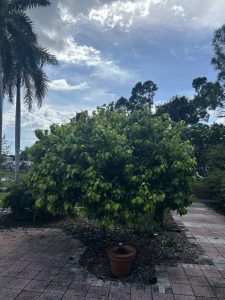 Cinnamomun verum
tree
The
culinary uses of cinnamon are extensive it is used dishes that range
from sweet to savory and has vast applications in many different
cultures’ culinary traditions. Cinnamon has the ability as a spice to
round bitterness, smooth sharpness, and adds depth making it able to
enhance both sweet and savory dishes. In Mexico it is a key spice
in Horchata and arroz con leche. In the middle east tagines and pilafs
rely on the spice to help form the depth of lamb or vegetable stews. In
India cinnamon is a key spice in garam masala. Incidentally garam
masala is different to every region and every family so the variability
of the cinnamon will differ depending on where you are and who you talk
to.
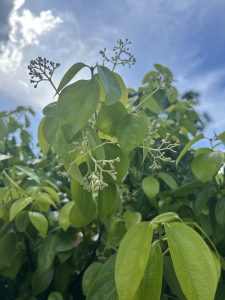 Cinnamomun verum
flowers
In all the cinnamon verum is a great addition to your garden
and can provide an immense array of culinary and medicinal additions to
your next endeavor in the kitchen. There is no comparison to its scent
in a fresh cinnamon roll or how it adds to the complex depth of a stew.
It is one of the most universally used spices across the world and
although we may not always know exactly which cinnamon we are using, we
can learn more about the differences in taste and applications of each
variety.
References Bandara,
Thusharie, et al. “Cinnamon as a Functional Food and Its Effects on
Human Health.” Critical Reviews in Food Science and Nutrition, vol. 52,
no. 9, 2012, pp. 813-828. Pathak, Rashmi, and Himanshu
Sharma. “A Review on Medicinal Uses of Cinnamomum verum (Cinnamon).”
Journal of Drug Delivery and Therapeutics, vol. 11, no. 6-S, 2021, pp.
161-166. https://doi.org/10.22270/jddt.v11i6-S.5145.
Jayaprakasha, G. K., L. Jagan Mohan Rao, and K. K. Sakariah. “Chemical Composition of Volatile Oil from
Cinnamomum zeylanicum Buds.” Zeitschrift für Naturforschung C, vol. 58, 2003, pp. 990-992.
Krishnamoorthy,
B., and J. Rema. “Botany and Horticulture of Cinnamon and Cassia.”
Horticultural Reviews, vol. 26, 2000, pp. 163-188.
Ranasinghe, P., et al. “Medicinal Properties of ‘True’ Cinnamon (
Cinnamomum zeylanicum): A Systematic Review.” BMC Complementary and Alternative Medicine, vol. 13, 2013, article 275.
Ravindran, P. N., K. Nirmal Babu, and M. Shylaja, editors. Cinnamon and Cassia: The Genus
Cinnamomum. CRC Press, 2004.
Sharifi-Rad, Javad, et al.
“Cinnamomum
Species: Bridging Phytochemistry Knowledge, Pharmacological Properties
and Toxicological Safety for Health Benefits.” Frontiers in
Pharmacology, vol. 12, 2021, Article 600139.
https://doi.org/10.3389/fphar.2021.600139.
Singh, Neetu, et al. “Phytochemical and Pharmacological Review of
Cinnamomum verum
J. Presl: A Versatile Spice Used in Food and Nutrition.” Food
Chemistry, vol. 338, 2021, Article 127773.
https://doi.org/10.1016/j.foodchem.2020.127773.